Readings that add up to a trend
Logging a uric acid result takes about ten seconds. What you get back is the line — where you are against your target, and whether the last three months moved.
Five things, chosen because they are what a gout appointment actually turns on: your uric acid trend, whether you took the medication, when the flares were, what you ate, and a document that carries all of it into the room. Everything stays on your iPhone.
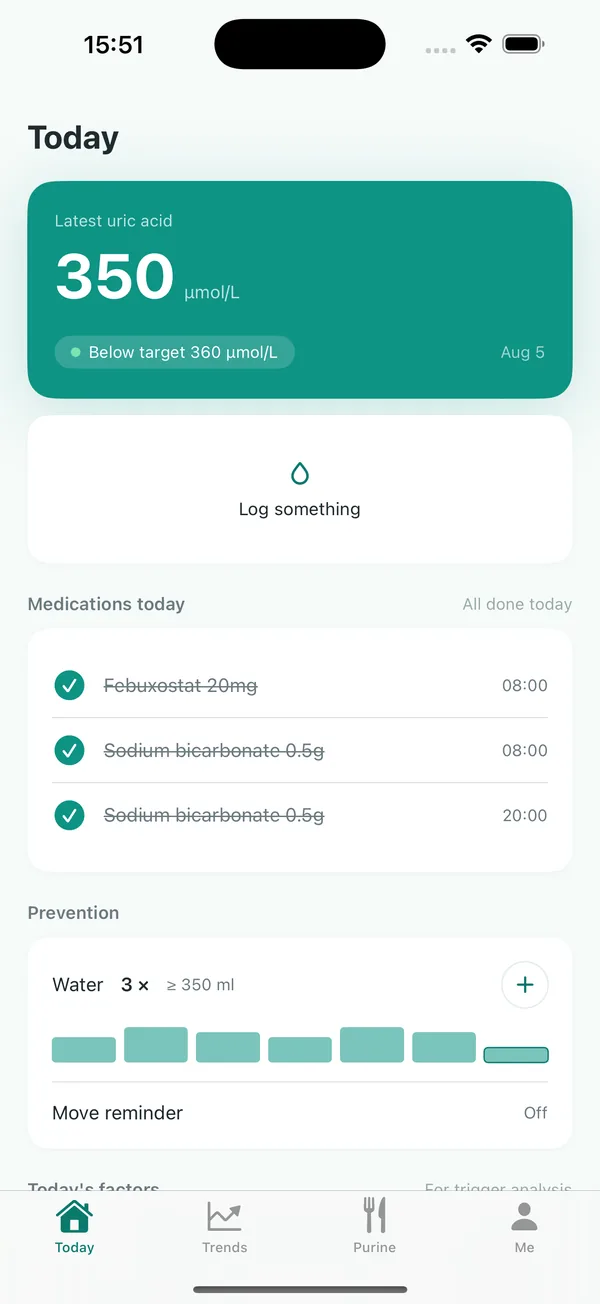
Logging a uric acid result takes about ten seconds. What you get back is the line — where you are against your target, and whether the last three months moved.
Adherence and flares are the two things a doctor asks about and nobody remembers accurately. Both are one tap.
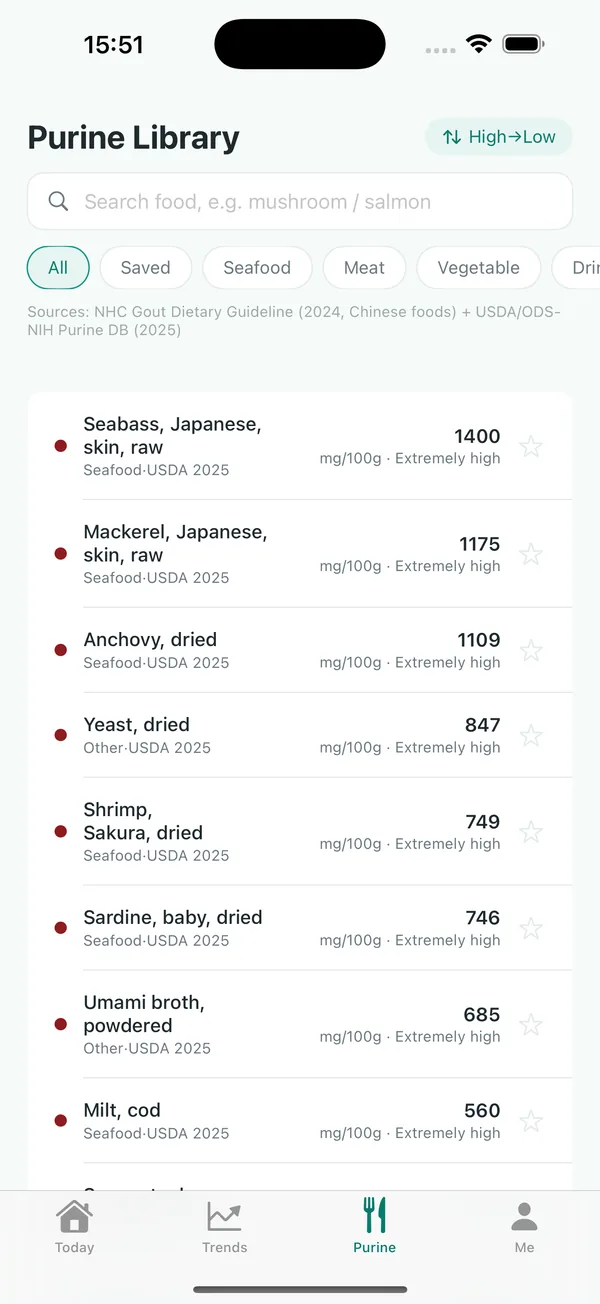
The purine database you can search on this site, in your pocket and working with no signal — which is when you actually need it.
Entering a reading is a number, a time and an optional note — about ten seconds, because the interaction budget is what decides whether a tracker survives past week three.
The chart plots week, month, six months or all time, with your target drawn as a reference line and its guideline source named on the screen. Alongside it sits your in-target rate for the last three months, phrased as a fact — how many readings were at or below target — rather than as a score.
Units are a global switch between µmol/L and mg/dL. Internally every reading is stored in one unit and converted for display, so switching never rewrites your history or introduces rounding drift into old entries.
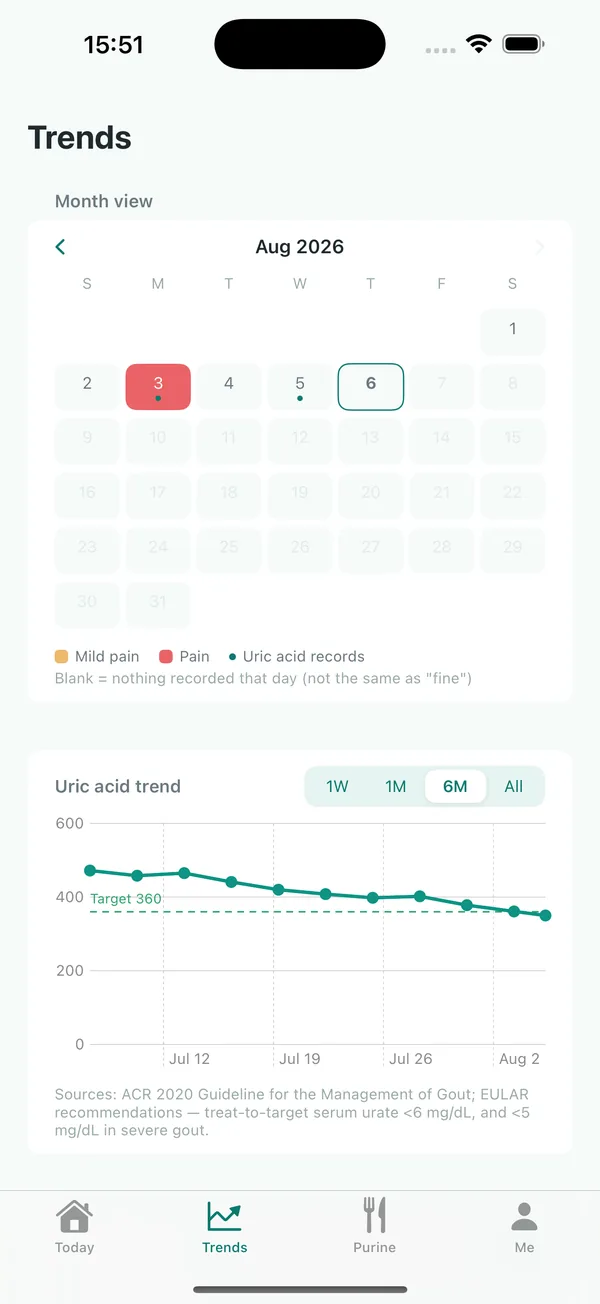
Add a medication with its dose, frequency and reminder times. Notifications are local to the phone and fire whether or not the app is open; confirming a dose is one tap, and a missed one can be filled in later.
The calendar view shows the month at a glance with an adherence percentage. Roughly two in five people with gout do not take urate-lowering medication as prescribed, and it is the single most consequential thing a doctor can know that a memory cannot reliably supply.
Medication names are free text on purpose. Breeze does not ship a drug database and does not suggest what to take — that would make it something other than a record.
During a flare nobody wants to fill in a form. The button on the home screen records that one is happening in a single tap; pain level, affected joints and what you did about it can be added when you feel like it, or never.
Alongside flares you can tag daily factors — alcohol, a high-purine meal, a late night, hard exercise, getting cold — in a few seconds of chip-tapping.
Once there are at least three flares on record, Breeze reports how often each factor appeared in the 48 hours before them: 'alcohol appeared in 4 of 6 flare windows'. It is deliberately a frequency and not a cause. Correlation in a handful of self-recorded events is not causation, and an app that pretends otherwise is lying to someone about their own health.
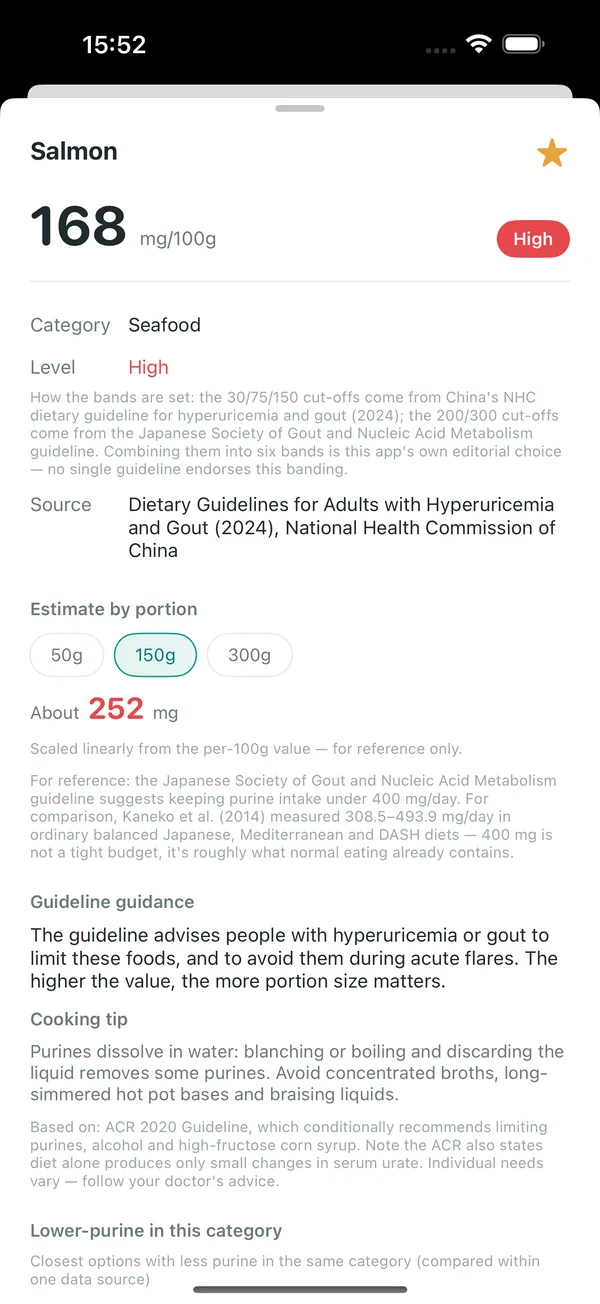
The same database you can search on this site, bundled into the app so it works with no connection — which is the situation you are usually in when the question comes up, halfway through reading a menu.
Search accepts English, Chinese characters or pinyin. Results are colour-coded across six levels, sorted highest-purine first by default because the practical question is normally what to skip. Foods you check often can be starred.
Every entry carries its own source, and the two source databases are never blended. Where a food exists in both, the guideline value is used for the Chinese entry rather than mapping one language's food names onto the other's — approximate name mapping is the most common reason a purine app quotes a number belonging to a different food.
Search the database in your browser — no install needed.
One tap produces a report covering the period since your last visit: the uric acid trend, the in-target rate, medication adherence, every flare with its detail, and the factor summary.
It exports as a PDF you share through the normal iOS share sheet — email it ahead, or show it on the screen. The footer states that the data was recorded by the patient and is for reference, because a clinician should know the provenance of what they are handed.
There is also a follow-up section: the date of your next appointment with a reminder, and a running list of questions you meant to ask. Both exist because the ten minutes go quickly and the question you forgot is the one you wanted answered.
No account, no cloud, no analytics SDK. Readings, medications and flares live in a database on your iPhone and are never uploaded.
This has a consequence worth stating plainly: if you delete the app without exporting, the data is gone, and we cannot recover it for you. That is the trade for nobody else ever holding your health record.
Full export is available at any time as a JSON file, plus the PDF report — data you can take with you rather than data locked in.
Privacy
The short version of the privacy policy, which is short because the architecture is.
Breeze records and summarises health data you enter. It is not a medical device, does not diagnose, and does not recommend treatment. Medical reference values are shown with the guideline and year they come from; your doctor decides what applies to you.
Version 1.0 is free and carries no ads. English and Simplified Chinese, iOS 16 and later. There is an optional Breeze Pro subscription, and every capability described on this page is in the free app.